
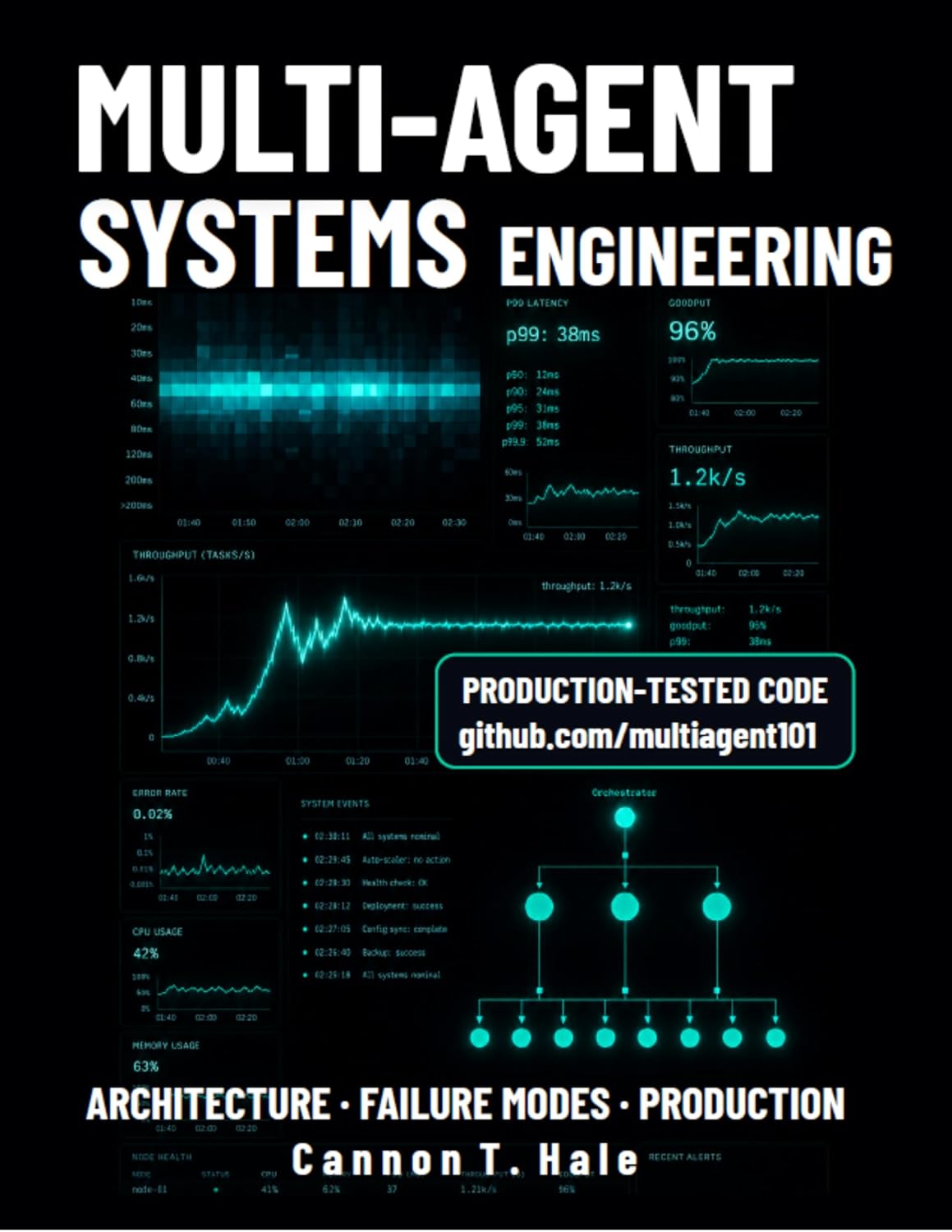
Multi-Agent Systems Engineering: Design architecture with evidence: metrics, risk gating, failure modes, and tested reference code—benchmarks, debugging, and production hardening for AI agents
Product details
| Management number | 231601504 | Release Date | 2026/06/18 | List Price | US$13.74 | Model Number | 231601504 | ||
|---|---|---|---|---|---|---|---|---|---|
| Category | |||||||||
Most multi-agent books teach you what the architectures are. This one puts you in the position where you already know which one breaks first — and exactly what to do about it.If you've ever shipped a multi-agent system that worked perfectly in isolation and fell apart under real load, you already understand the problem. The architecture wasn't wrong. The decision framework was missing. You were making structural choices by intuition, measuring the wrong things, and finding out about failure modes in production instead of before it.After reading this book, that changes.You'll be the engineer who walks into an architecture review and knows — with numbers — which coordination model fits the system in front of you, where it will saturate, and what it will cost when it does. You'll run fault injection before your system hits production, not after. You'll instrument your agents so that when something goes wrong at 2am, you reconstruct exactly what happened from the trace — not from guesswork.The book is built around three coordination models: centralized orchestration, distributed peer architectures, and market-based allocation. You learn the authority boundaries that make each one work, the failure modes that make each one break, and the quantified thresholds that tell you when to switch. By Chapter 5, you're not choosing architectures by intuition. You're choosing by measurement.This is the only book in the category that tells you — with measurable thresholds — when not to build what you're planning to build.3 coordination models, fully benchmarked. Centralized, peer, and market architectures — with the exact saturation points, failure modes, and recovery envelopes for each one.1 decision algorithm to choose between them. A quantified selection framework that takes your system's constraints as input and returns a defensible architecture recommendation.6 resilience primitives, implemented and tested. Circuit breakers, bulkheads, leases, idempotency store, outbox, retry policies — each connected to the failure scenario it prevents.7 criteria to know when to stop. A quantified framework for deciding when multi-agent coordination is the wrong tool — the only one of its kind in the category.34 production-tested code listings. Every implementation runs on day one. No broken snippets, no missing dependencies — all freely accessible at github.com/multiagent101.28-point production readiness checklist. The exact checkpoints to clear before you ship — from lease validation to cascade isolation to upgrade safety.Free Decision Toolkit included — interactive architecture wizard, real-time risk gating scorecard, and the full production checklist at multi-agent-system-decision-toolkit.netlify.app. No download, no signup.No framework lock-in. No academic detours. No filler chapters. Every decision in this book connects to a measurable outcome.For software engineers, system architects, and AI practitioners who need structured system design — where choices are explicit, risks are quantified, and performance is understood before you ship.Some engineers guess. Others know. The difference is a framework. Read more
| ASIN | B0GZL2CGH7 |
|---|---|
| XRay | Not Enabled |
| Language | English |
| File size | 12.6 MB |
| Page Flip | Enabled |
| Word Wise | Not Enabled |
| Print length | 656 pages |
| Accessibility | Learn more |
| Screen Reader | Supported |
| Publication date | May 5, 2026 |
| Enhanced typesetting | Enabled |
Bestseller ranking
Heater Blend Door Levers


Customers who viewed this product also viewed
Expert Systems


Correction of product information
If you notice any omissions or errors in the product information on this page, please use the correction request form below.
Correction Request Form